
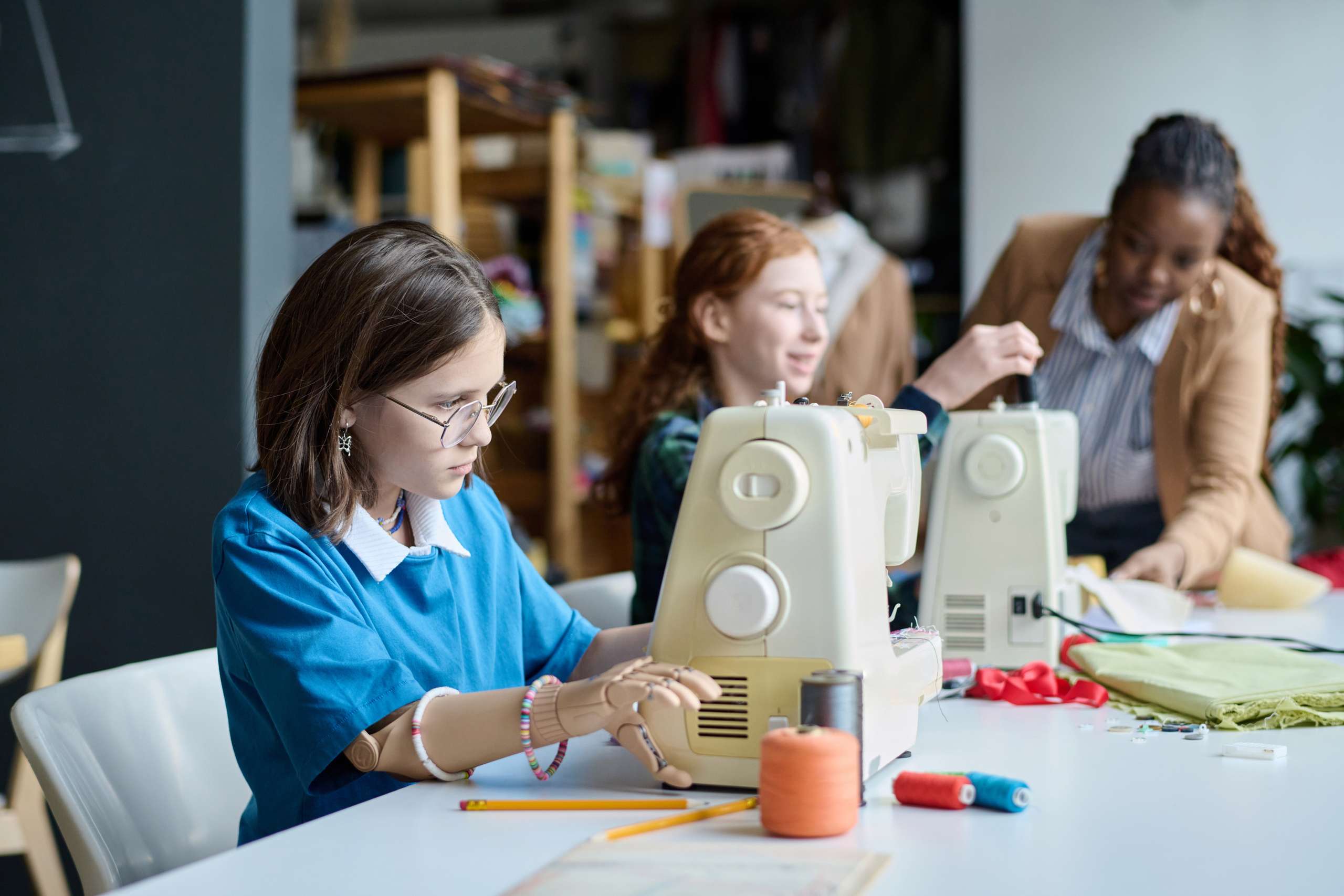
In the beginning, many people want to sew a garment: a dress, a jacket, or something else that has lining, shaping, and so on. This is natural, but if you want to learn how to sew, you need a project that enables you to practice basic moves several times without making the project too complicated. A simple bag is the best project for this. The bag shape is simple, the seam length is short, and the fabric needed is inexpensive. But more importantly, you will learn the basic motions of sewing: measuring, cutting, sewing straight lines, and finishing seams. Because the item is small, you are not too disappointed if you fail, and you can concentrate on the behavior of the fabric as you sew.
To start, take two fabrics that are about the size of a notebook sheet. I would recommend cotton because it is easy to keep its shape and does not slip as you sew. Cut the two pieces of equal size. Then put the right sides of the fabrics together and match edges carefully. You can use some pins along the edge to prevent the fabric from slipping while you sew. At this point, it is not necessary to sew fast. What is important is that you can control the movement of the fabric as you sew. Try to move the fabric slowly while keeping the distance between the edge of the fabric and the edge of the presser foot constant. If the distance is not constant, it will affect the shape of your bag.
One typical error is when the novice pulls the fabric forward while the machine is feeding it. This often results in wavy seams or uneven stitches. Instead of pulling the fabric, let the machine feed the fabric and just guide it. If your seam starts to be curved, stop the machine, lift the presser foot, and adjust the fabric position so that the edge of the fabric is aligned with the edge of the presser foot again. It is important to correct as soon as you notice the deviation, because a small deviation will become bigger as you continue sewing. Sewing slowly may not feel like real sewing, but it will help you develop muscle memory that enables you to sew fast and straight later.
Sewing a simple bag is a good way to repeat the motions without getting bored. One strategy that works for me is as follows: take about 15 minutes to cut and sew a bag. The next day, sew another bag using a different fabric, and focus on one particular aspect of the sewing, say straightness of the seam or how to turn the corner nicely. On the third day, focus on how to trim the extra fabric in the seam allowance or how to press the seam nicely. These daily practices help you improve your skill because you can focus on one thing at a time.
The simple bag can also become a platform for experiments. For example, you can change the length of stitches and see how it affects the strength of the seam. You can try a slightly thicker fabric and see how it affects sewing. You can make a casing for a drawstring and see how to make a channel. If you are able to try different things, the simple bag will not be so boring anymore. Also, by repeating making the same thing, you will be comfortable with your machine, and you will develop the sense of control over the fabric. Once you feel like it is easy to make a simple bag, your hands will have learned most of the moves that you need for more complicated projects.